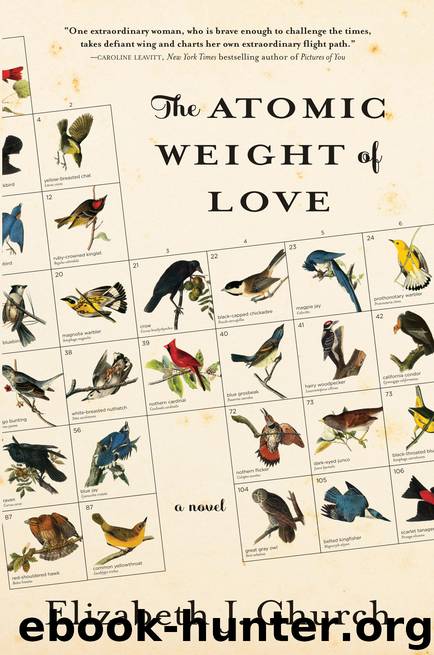
The Atomic Weight of Love by Elizabeth J. Church
Author:Elizabeth J. Church
Language: eng
Format: epub
Publisher: Algonquin Books
Published: 2016-04-13T04:00:00+00:00
An Exaltation of Larks
1. Literature celebrates larks’ melodious, extravagant song.
2. “Exaltation,” derived from the Latin exaltare, means to “raise aloft.”
It was Vietnam, finally, that reminded the world of the existence of Los Alamos. With the immediate threat of World War II forgotten, Los Alamos was transfigured. It was no longer the place where extraordinary minds and talents had converged to put an end to war.
Wearing a petal-pink cotton shift, my hair grown out nearly to my shoulders, I came out of the Safeway one early summer afternoon in 1968 to stand with other housewives who were watching a parade of hippie buses traveling down Central Avenue. Scruffy kids emerged carrying signs that called Los Alamos an “atomic proving grounds.” They beat drums and chanted something I couldn’t make out, and then they concluded their protest beside Ashley Pond, where they lay on the grass playing wooden flutes and shaking tambourines.
They either conveniently forgot or determinedly ignored what Los Alamos had accomplished in terms of lives saved—maybe even the lives of the fathers of these self-same hippies. I didn’t mind that they protested, but I did mind their overly simplistic, self-serving analysis. I minded purposeful, nearsighted ignorance.
I wondered what Belle would have had to say about it all—if she would have sat cross-legged with the kids or if she would have yelled back at the protestors, ridiculed their signs and banners.
In the end, I rather think she would have swirled the ice in her cocktail glass thoughtfully and then said: “Thank God it’s not my son dying over there.”
The Los Alamos antiwar protests were sporadic, but hippies and protest marches seemed omnipresent on television. As 1970 arrived, I watched the parade of young men and women, their wild, creative explosion of clothing and hair, and I wondered what it would be like to talk—really talk— with some of them. Could we have a genuine conversation? Or would they dismiss me as someone over thirty and thus irrelevant?
I WAS PERCHED ON my favorite observation post, blank pages of my crow journal before me. I watched Withered Foot’s son, a crow with a patch of remarkable white flight feathers near the tip of his left wing. White Wing was trying to win a mate as he dove, circled, hovered, and soared above me. Two females perched in the uppermost boughs of separate ponderosa pines, and both were clearly interested in White Wing. This year he would inherit Withered Foot’s territory and establish his family in that portion of the canyon. Although snows were rare this late in the year, they remained a possibility, and I wanted to see if young, inexperienced crows such as White Wing and his mate could outwit the variability of spring in northern New Mexico.
All at once, the crow community began cawing an alert, signaling the presence of an intruder. I closed my journal and looked about me. Across the canyon, I heard rock falling followed by a distinct, effortful grunt. I moved so that I could see through an opening in the trees, and I focused my binoculars.
Download
This site does not store any files on its server. We only index and link to content provided by other sites. Please contact the content providers to delete copyright contents if any and email us, we'll remove relevant links or contents immediately.
The Hating Game by Sally Thorne(19733)
Still Me by Jojo Moyes(11498)
Most of All You by Mia Sheridan(9614)
The Break by Marian Keyes(9522)
Where the Crawdads Sing by Delia Owens(8769)
The Kiss Quotient by Helen Hoang(7416)
Little Fires Everywhere by Celeste Ng(7409)
Small Great Things by Jodi Picoult(7344)
Darker: Fifty Shades Darker as Told by Christian (Fifty Shades of Grey Series) by E L James(7334)
Burn for You (Slow Burn Book 1) by J.T. Geissinger(7192)
Into the Water by Paula Hawkins(7072)
The Seven Husbands of Evelyn Hugo by Taylor Jenkins Reid(6849)
The Mistress Wife by Lynne Graham(6598)
Without Merit by Colleen Hoover(6152)
Beach Read by Emily Henry(5661)
Royally Screwed by Emma Chase(5396)
Eleanor Oliphant Is Completely Fine by Gail Honeyman(5396)
Elite Ops - 01 - Wild Card by Lora Leigh(5205)
Beloved (The Salvation Series Book 1) by Corinne Michaels(4781)
